
If you own a vacation rental in San Diego County — or you’re thinking about buying one — the first question is always the same: what will it cost to have someone manage it?
The short answer is that most San Diego vacation rental managers charge 15% to 30% of gross rental revenue, with true full-service management typically landing in the 20% to 30% range. But that number alone tells you almost nothing about whether a company is worth hiring. A cheaper percentage that leaves you with empty weeks and 4.2-star reviews costs more than a higher one that keeps your home booked, priced right, and maintained.
Here’s how to read the fee landscape like an owner, what to look for beyond the percentage, and how to compare companies on the number that actually matters: your net income.
The 2026 Fee Landscape in San Diego
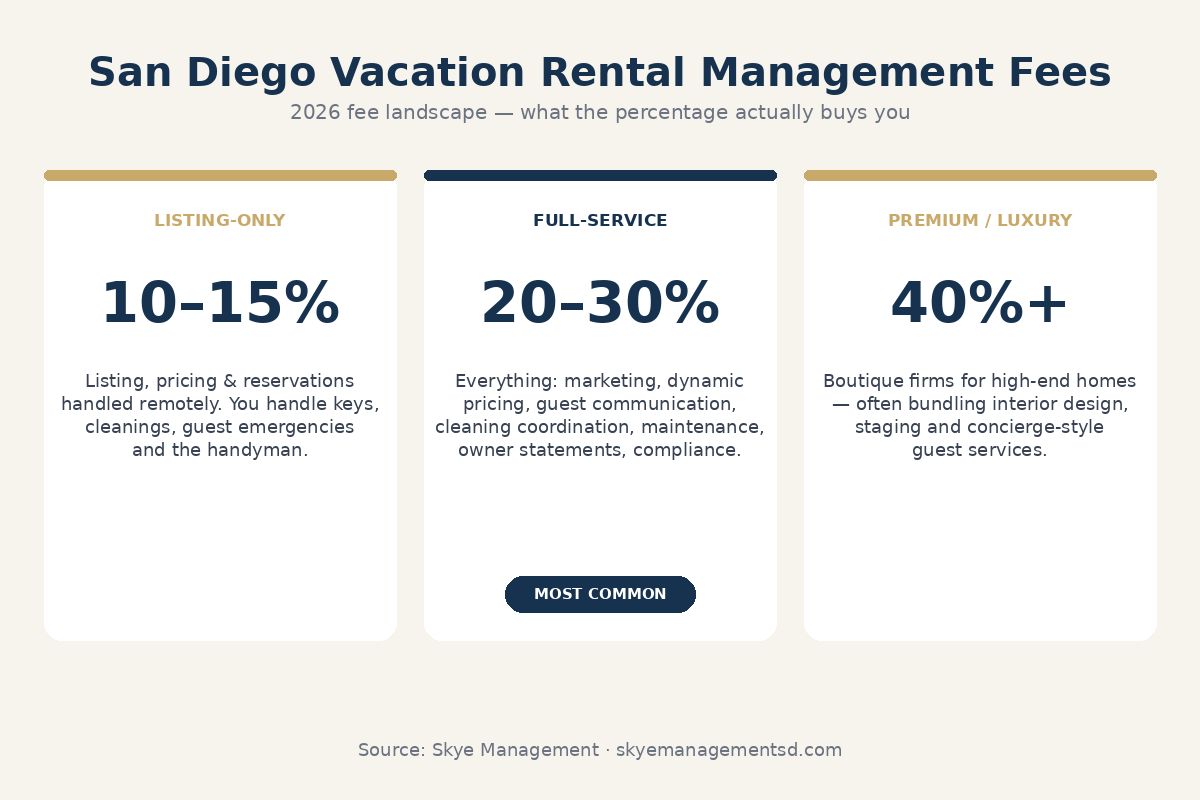
Vacation rental management pricing falls into three broad tiers in the San Diego market:
- Offsite / listing-only services (10–15%) — The company handles your listing, pricing, and reservations remotely. You (or someone you hire) handle the keys, the cleanings, the guest emergencies, and the handyman. This works only if you have reliable local help of your own.
- Full-service management (20–30%) — The company handles everything: marketing, dynamic pricing, guest communication, cleaning coordination, maintenance, owner statements, and platform management across Airbnb and Vrbo. This is what most owners think of when they say “property manager.”
- Premium / luxury operators (up to 40%+) — Boutique firms managing high-end homes, often bundling interior design, staging, and concierge-style guest services. The percentage is higher because the service — and usually the revenue — is, too.
Why the wide spread? Scope. A 15% manager and a 28% manager are not selling the same product. The 28% company is usually pricing your home nightly, responding to guests in minutes, coordinating cleaners and maintenance vendors, and keeping you compliant with local rules. The 15% company may be doing half of that and leaving the rest on you.
What’s Actually Included in “Full Service”
The phrase “full service” isn’t standardized, so always get the list in writing. A genuinely full-service San Diego vacation rental manager should include:
- Listing creation and optimization on Airbnb, Vrbo, and their own direct-booking site
- Professional photography and listing copywriting
- Dynamic nightly pricing adjusted to San Diego’s seasons, events (Comic-Con, holiday weeks, spring break), and local demand
- Guest communication, from inquiry through checkout — nights, weekends, holidays
- Cleaning and turnover coordination, with inspections between guests
- Maintenance and repair coordination with trusted local vendors
- Owner accounting and monthly statements
- Permit and tax compliance support — more on this below, because in San Diego it matters a lot
If any of those are missing from the proposal, you’re not comparing full-service to full-service — and the cheaper quote is an illusion.
The Charges That Live Outside the Percentage
This is where owners get surprised. The management percentage is rarely the whole cost. Ask about every one of these before you sign:
- Onboarding fees. Some companies charge a one-time setup fee covering photography, listing creation, and initial stocking. Reasonable — just know it exists.
- Cleaning fees. Most managers pass the cleaning cost through to the guest as a separate line item on the booking, which is standard. Ask whether the company adds a markup to cleanings and whether you can see what the cleaner actually charges.
- Maintenance markups. Some companies add 10–20% on top of vendor invoices. Others bill at cost. This is one of the biggest hidden-cost differences between companies, and it’s worth asking about directly.
- Linen and supply programs. If the company runs a linen service, ask what it costs per turnover and whether it’s optional.
- Platform and payment fees. Airbnb and Vrbo take their own cut (host service fees) on top of your manager’s percentage. That’s platform cost, not management cost — but factor it into your net-income math.
- Permit and licensing fees. The City of San Diego requires a Short-Term Residential Occupancy (STRO) license for vacation rentals, and enforcement has tightened since 2025. Coastal cities like Carlsbad, Encinitas, and Oceanside each run their own rules. A good manager helps you stay compliant; some charge a small annual fee for handling renewals and filings.
None of these make a company “expensive” on their own. What matters is transparency: a company that itemizes everything upfront is almost always cheaper in practice than one whose quote is a single suspiciously low number.
How to Compare Companies: Price Per Net Dollar
Forget comparing percentages. Compare projected net income. Here’s the math:
A manager charging 28% who earns your home $90,000/year in gross revenue nets you $64,800 before other costs.
A manager charging 20% who earns your home $72,000/year nets you $57,600 before other costs.
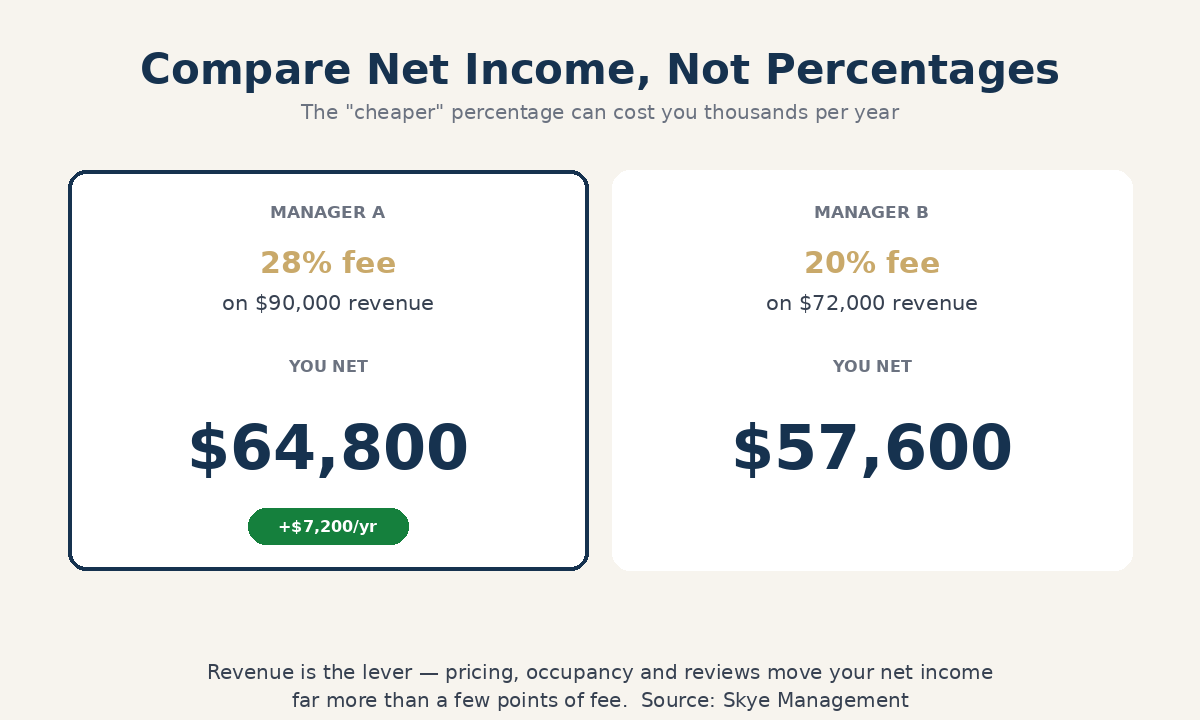 The “cheaper” manager just cost you $7,200 a year. Revenue is the lever — dynamic pricing, search ranking, review scores, and occupancy rate move your net income far more than a few percentage points of fee.
So when you’re interviewing companies, ask for revenue-side evidence:
- What occupancy rates do your San Diego homes average? Not the cherry-picked best one — the portfolio.
- How do you price? “We use dynamic pricing software” is a start. “Here’s how we priced a 3-bedroom in North Park through Comic-Con week versus January” is an answer.
- What’s your average review score across listings? Below 4.7 across a portfolio is a red flag in San Diego’s competitive market.
- Can I see a sample owner statement? It shows you exactly what fees appear, how they’re labeled, and whether the accounting is clean.
Questions to Ask Before You Sign
Take this list to every interview. The answers matter more than the brochure.
- What’s included in the percentage — specifically? Get the service list in writing.
- What charges exist outside the percentage? Onboarding, linen, maintenance markup, permit handling — all of it.
- How long is the contract, and what does it cost to leave? Long lock-ins with big termination fees deserve scrutiny.
- Who owns the listing and the reviews? If you leave, do the listing, photos, and reviews come with you — or do you start from zero? This matters enormously.
- How do you handle the STRO license and TOT (transient occupancy tax) filings? In San Diego, this is not a detail — it’s a compliance obligation.
- What’s your response time to guests? Minutes matter for booking conversion and review scores.
- Can I talk to two current owners? Any good company will say yes immediately.
A Quick Word on Self-Managing
Plenty of owners start by self-managing, and for a single nearby condo it can work — for a while. But count the real cost: nightly pricing research, guest messages at 11 PM, cleaner coordination, maintenance calls, platform algorithm changes, STRO renewals, and tax filings. Most owners we talk to discover that “free” management was costing them 10–15 hours a week plus the revenue they left on the table with static pricing. The question was never whether management costs money. It’s whether it makes you more than it costs.
The Bottom Line
In 2026, expect to pay 20–30% for genuine full-service vacation rental management in San Diego, plus transparent pass-through costs for cleaning, maintenance, and compliance. Don’t hire the lowest percentage — hire the company that nets you the most after everything is paid. Ask for the service list, the sample statement, and the revenue evidence, and you’ll spot the right partner fast.
Thinking About Professional Management for Your San Diego Rental?
Skye Management is a family-owned vacation rental management company serving San Diego County. We handle everything — pricing, marketing, guests, cleanings, maintenance, and compliance — and treat your property like it’s our own. Call us at 858-775-5904 for a free revenue estimate on your home. No pressure, just the numbers.
